• Service Areas
    • Branford, CT
    • Cheshire, CT
    • Clinton, CT
    • Guilford, CT
    • Meriden, CT
    • Middletown, CT
    • New Britain, CT
    • New Haven, CT
    • North Haven, CT
    • Southington, CT
    • Wallingford, CT
    • West Hartford, CT
  • Services
    • What We Offer
    • Construction Management
    • Condo Management
  • About Us
  • Resources
    • Board Member Resources
    • Investor Resources
  • Testimonials
  • Blog
  • Contact Us
  • Resales / Questionnaires

Call us 203 741 9628

Info@InsightREM.com
Owner / Resident Login
Insight Real Estate & ManagementInsight Real Estate & Management
  • Service Areas
    • Branford, CT
    • Cheshire, CT
    • Clinton, CT
    • Guilford, CT
    • Meriden, CT
    • Middletown, CT
    • New Britain, CT
    • New Haven, CT
    • North Haven, CT
    • Southington, CT
    • Wallingford, CT
    • West Hartford, CT
  • Services
    • What We Offer
    • Construction Management
    • Condo Management
  • About Us
  • Resources
    • Board Member Resources
    • Investor Resources
  • Testimonials
  • Blog
  • Contact Us
  • Resales / Questionnaires
21 Oct
0

The Part of Your Roof Nobody Bids On

Posted by Stephen DeBaise Construction Management No comments

Why ventilation belongs in every roofing scope, and why most associations don’t know to ask.
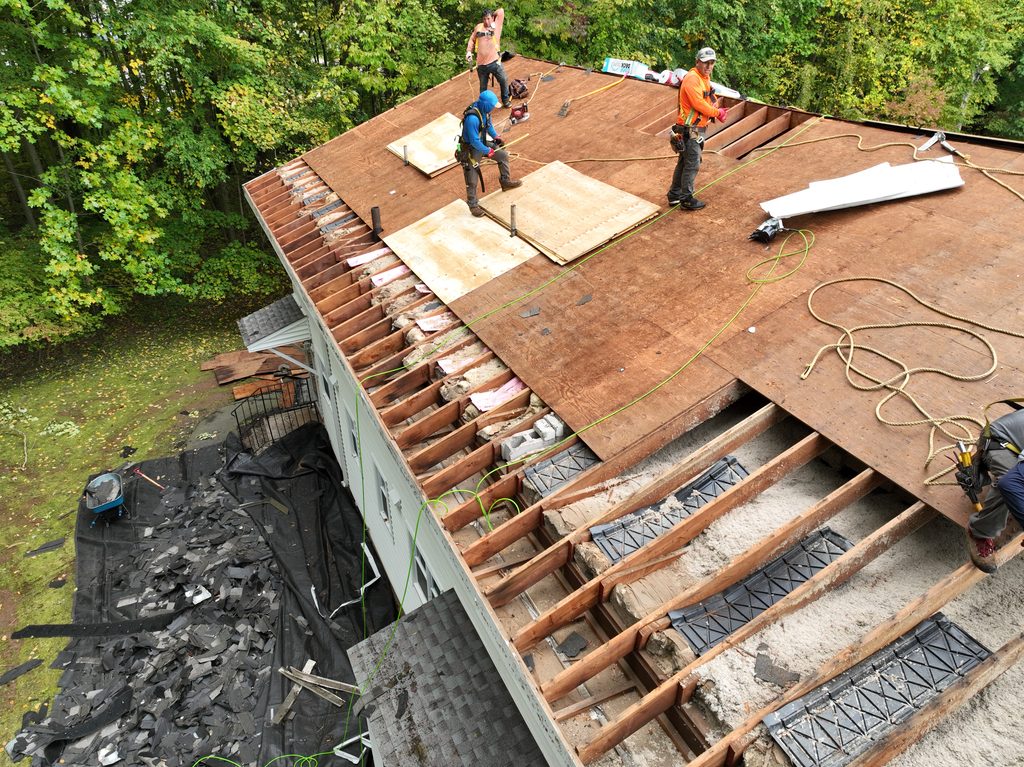
When an association replaces a roof, the conversation usually centers on what owners can see: shingle color, brand, warranty length, price per square. Those things matter, but some of the most important decisions on a roofing project happen in the part of the roof that is rarely looked at.

The photo above is a good example. With the decking stripped away, you can see what’s normally hidden: the rafters, the insulation, the channels at the eaves. That space has a job to do. Whether it does that job well is decided by the roofing scope, and in a lot of scopes it isn’t mentioned at all.

A roof is a system

Shingles are the surface. Underneath is a system that has to manage heat and moisture year round. When that system works, nobody notices. When it doesn’t, the problems tend to show up as something else entirely, which is why they’re so often misdiagnosed.

What poor ventilation can look like at an association:

  • Ice dams along the eaves every winter
  • Shingles curling, blistering, or wearing out years ahead of schedule
  • Mold or staining on the underside of the decking
  • Soft or delaminated decking discovered at the next tear-off
  • Top-floor units that run hot in summer, with energy bills to match
  • A warranty claim that gets denied

That last one surprises many boards. Shingle manufacturers generally expect the roof to be properly ventilated, and a ventilation problem can affect warranty coverage. A long warranty on paper is only as good as the installation behind it.

Why it gets left out

Ventilation rarely makes it into a scope for a simple reason: nobody at the table knows to put it there.

Many bids are written as a straight replacement of what’s already on the building. If the existing setup was wrong, a like-for-like bid repeats the mistake on a brand-new roof. Contractors bidding against each other on price have little reason to add scope nobody asked for. And board members, understandably, aren’t roofing experts.

The result is that three bids can look nearly identical and still deliver very different roofs.

Questions every board should be able to answer

Before approving a roofing contract, a board should be able to answer these:

  • Has anyone evaluated whether the current attic ventilation is working?
  • Does the scope say what will be done about ventilation, or is it silent?
  • Are all the bids actually pricing the same system?
  • Will the finished roof meet what the manufacturer expects for the full warranty?
  • Who on our side is qualified to check?

If the honest answer to any of these is “we’re not sure,” that’s the gap.

A good scope is only half the job

Even the best scope is just a document. What protects the association is whether the roof that goes on actually matches it.

Once work starts, things come up. Conditions change when the old roof comes off. Change orders get proposed. Details that matter get rushed when nobody is watching. A scope can say all the right things and still not be followed.

That’s where the right management team comes in. Having someone on the association’s side means the right questions get asked before the work starts and keep getting asked until it’s finished: coordinating with the contractor, unit owners, and making sure the scope is followed.

The bottom line

A roof replacement is one of the largest checks an association will write. The difference between a roof that reaches its full life and one that fails early is often decided before the first shingle comes off, in a scope document most owners never read.

You don’t need to become a roofing expert. You need a management company that knows the right questions to ask, and stays on your side until the job is done right.

Planning a roof replacement? Make sure the scope covers the whole system.

Our team asks the right questions before a roofing scope goes out to bid, so ventilation isn’t an afterthought and every bid is pricing the same job. Then we stay on your side through completion, making sure what was promised is what gets built. Before your board signs a contract, let’s talk.
Talk to our team about your roofing project →

Read more
15 Oct
0

The Most Expensive Roof Is the One You Wait to Replace

Posted by Stephen DeBaise Construction Management, Emergency Work, Uncategorized No comments

How one association’s deferred roof project turned into $135,000 of avoidable spending, and what boards can learn from it.

Every association board has had this conversation. The roofs are near the end of their life, the reserve study says replacement is due, and someone asks the reasonable question: can we get a few more years out of them?

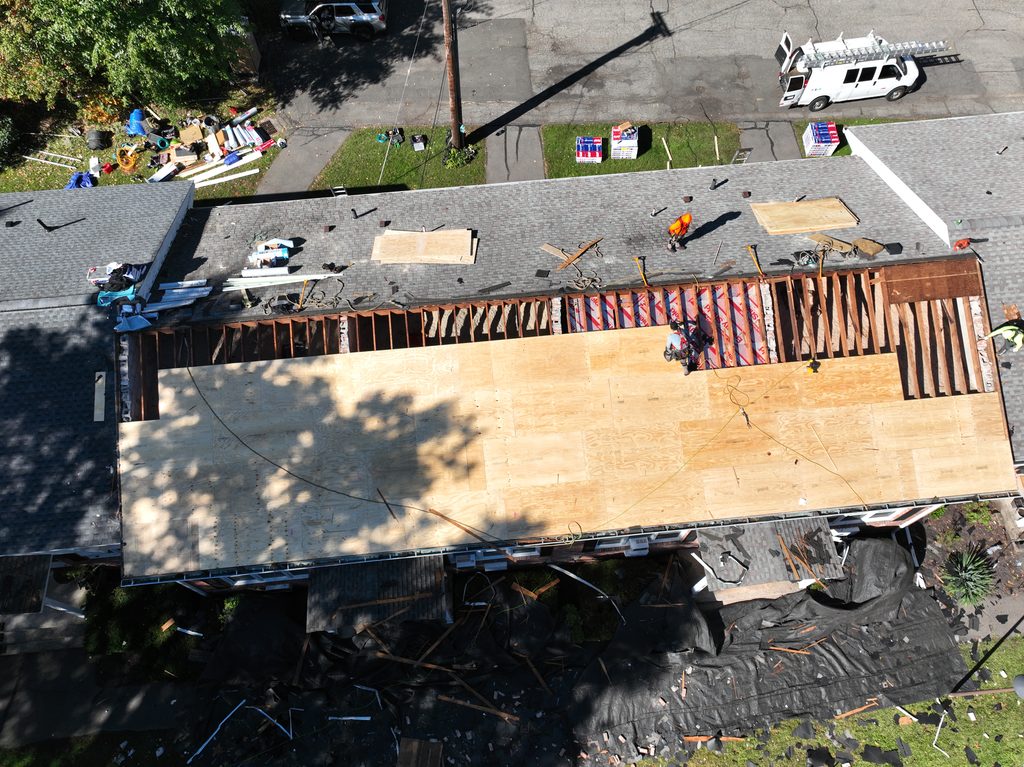
We recently managed a full roof replacement for an association that had deferred the project. The photo above tells the entire story. Instead of a straightforward tear-off and re-shingle, the roofers stripped this building down to the rafters and replaced the roof decking across the entire roof field.

What waiting actually cost

By the time the project moved forward, the association had already spent roughly $50,000 on remediation and rebuilding units after leaks. On top of that came about $5,000 in emergency tarping. It started with small tarps over problem spots. As the roofs got worse, the association ended up tarping every roof on all five buildings, at about $1,000 per building. None of that money improved the building. It only held the line.

Then came the largest hit. Years of water getting past worn shingles had damaged the plywood decking underneath. What should have been a shingle replacement became a full decking replacement, an estimated $80,000 that a timely replacement would likely have avoided.

In other words, delay didn’t save this association money. It cost it.

Why roofs get more expensive the longer you wait

A roof fails in stages, and each stage costs more than the last.

  1. Shingles wear out. Granules wash off, edges curl, and seals fail. At this point, replacement is mostly labor and materials for the top layer.
  2. Water gets underneath. Small leaks soak the decking, often without showing up inside right away.
  3. Decking rots or delaminates. Soft or damaged plywood can’t hold nails and has to be replaced before new shingles go on.
  4. Damage spreads inside. Ceilings, insulation, drywall, and sometimes framing need restoration. Emergency tarping and repeat service calls pile up.

A replacement done at stage one is a planned capital project. A replacement done at stage three or four is a planned project plus eating into the majority of contingency funds.

The same math applies to wood siding

Wood siding follows the same pattern. Paint and caulk are the first line of defense. When they’re deferred, moisture gets into the boards, then the sheathing, then the wall framing. A paint-and-repair cycle turns into board replacement, and board replacement can turn into structural repair. The longer siding work waits, the more of the wall you end up paying to rebuild.

What boards can do

  • Treat the reserve study as a schedule, not a suggestion. If a component is due, plan for it or document why it’s safe to wait.
  • Get an inspection before you defer. A roofer or engineer can tell you whether the decking is still sound. That one visit can be the difference between a delay that’s safe and one that’s expensive.
  • Track reactive spending. Add up tarping, leak repairs, and interior restoration each year. When that number climbs, the case for replacement usually makes itself.
  • Communicate the trade-off to owners. A special assessment is never popular, but owners respond better when they can see what waiting would cost.

The bottom line

Deferring a capital project can feel like the fiscally responsible choice. Often it’s the opposite. For this association, waiting turned a roof replacement into a roof replacement plus an estimated $135,000 in remediation, tarping, and decking work that never had to happen.

If your community has roofs or siding approaching the end of their life, talk with your manager about where they stand before the decision gets made for you.

Schedule a capital planning review →

Read more
11 Oct
0

How a 60-Unit Cheshire Association Turned a $2MM Problem Into a Plan

Posted by Stephen DeBaise Construction Management, Loans No comments

The situation

When we started working with the Board of a 60-unit association in Cheshire, CT, the focus was on replacing the failing asphalt and sidewalks and the remediation of the shared basements. The association had no reserves, and that work was simply too expensive to pay for out of pocket.

About four months into planning, the roofs started leaking. We quickly pivoted, developed roofing specifications, and added new roofs and full gutter replacement on all five buildings to the project list. Together with the sidewalk and plumbing work, the total came to roughly $2 million. Paying upfront would have meant a special assessment of about $33,000 per unit, due all at once.

The real cost of waiting

Putting the work off wasn’t free either. Construction costs keep climbing, and on a $2 million scope that means roughly $120,000 more for every year the association waits. That’s about $2,000 per unit, per year, for the exact same work.

The leaks cost even more. The ceilings contained asbestos, so every leak meant testing, abatement, and rebuilding, at about $8,000 each. With all five buildings leaking, the association was spending money on repairs that never fixed the real problem.

The five projects

With a long-term loan, every component’s useful life matters. You can’t have something wearing out and needing replacement while the association is still paying for it. That’s why we chose concrete sidewalks over asphalt and specified enhanced details for the new asphalt.

New roofs and gutters on all five buildings. Every roof was about 30 years old and leaking. Replacing them stops water at the source and protects everything underneath. Full gutter replacement improves how the buildings handle water, which matters more each year as rainfall amounts increase.

Concrete sidewalks. The old asphalt walkways were cracked and heaving. Concrete costs more up front but has a much longer useful life.

Asphalt and parking expansion. The paving was failing, with large potholes throughout, and the community needed more parking. New asphalt is only as good as the plan behind it. A proper evaluation and a detailed scope of work are what make it last.

Asbestos abatement and mold remediation. Leaking unit owner’s plumbing had caused mold in the shared basements. Instead of working around asbestos-containing materials, the association is removing them completely. Future leaks become ordinary repairs, not abatement projects.

Plumbing upgrades. The association owns five hot water tanks, and many of its gate and ball valves were failing or seized. Replacing the tanks and valves gives the association reliable control of its plumbing again.

How the financing works

Leader Bank provided a $2 million loan that is repaid through a special assessment spread out over 20 years. Instead of a $33,000 lump sum, owners make manageable payments. Owners who would rather pay off their share in full can do so at any time.

The result: all five projects get done now, at today’s prices, and owners choose how they pay.

Why the right manager matters

This association had a few issues that affected its risk rating with lenders, and not every bank would have said yes. Leader Bank was able to provide the financing anyway. Getting there took a manager who knows what banks look for and which lender fits a given association.

If your association is facing deferred projects and thin reserves, Insight Real Estate & Management can help you evaluate the work, build the right scope, and find the right financing. Contact us to start the conversation.

Read more
19 Sep
0

$50,000 Lighting Project…Free?

Posted by Stephen DeBaise Construction Management

We recently completed a major lighting upgrade for one of our clients, a 62-unit apartment-style building. The project involved swapping out 118 light fixtures, improving both efficiency and the overall look of the property.

Here’s where it gets interesting:

  • Total project cost: $50,000
  • Eversource rebate: $23,000
  • Remaining balance: $27,000, financed over 5 years right on the client’s electric bill

By taking advantage of utility incentives, this project essentially paid for itself. In fact, after all is said and done, the building now enjoys a net electrical savings of $110 per month – all while reducing energy usage and maintenance costs.

This is a great example of how energy upgrades don’t have to be a financial burden. With the right planning, resources, and partnerships, a $50,000 project can feel almost…free.

Opportunities like this don’t happen by accident. A knowledgeable management partner understands how to leverage rebates, financing options, and vendor relationships to maximize savings and minimize out-of-pocket costs. Without the right guidance, projects like these can end up costing far more, or worse, never get off the ground.

Here are a few photos:

Read more
26 May
0

Roof Replacement Project Completed in Southington

Posted by Stephen DeBaise Construction Management

Insight recently completed a full roof replacement project at a condominium in Southington. From initial planning through final inspection, we coordinated every phase of the job to ensure minimal disruption to residents and long-term value for the association.

We secured a $280,000 loan, on behalf of the association, through Windsor Federal Bank to fund the project. Insight guided the board through the loan process — from application to unit owner approval — ensuring the financing was structured to meet the community’s long-term financial goals.

Our team sourced multiple bids, reviewed warranties and materials, and worked closely with the board to select the most qualified roofing contractor. We then managed communication with residents, oversaw scheduling, and ensured the contractor remained on time (although Mother Nature had other plans) and on budget.

Throughout the project, numerous unit owners commented on how professional and courteous the roofing team was. Residents were extremely pleased with both the process and the final outcome.

The project was completed safely, efficiently, and with excellent workmanship. This is another example of how insight delivers proactive management and oversight for capital improvements — protecting the association’s investment and giving homeowners peace of mind for years to come.

Read more
26 May
0

Power Out, Game On: How We Solved the Case of the Buried Break

Posted by Stephen DeBaise Emergency Work

At 7:30 AM, we received a call from a unit owner reporting that half her condo had lost power. By 8:00 AM, Stephen was on site, meeting with a United Illuminating (UI) supervisor to investigate the issue.

Initial diagnostics revealed a fault between the unit owner’s meter and the pad-mounted transformer. Recognizing the issue’s complexity, Stephen brought in one of insight’s trusted electricians to assist in troubleshooting.

It was quickly determined that the best course of action was to involve a UI line crew to physically pull the underground service line to locate the exact failure point.

Once the transformer was opened, it became clear we were in for a challenge: not only were the service lines unlabeled, but a few labels were incorrect. After methodically identifying the correct service line, the transformer was disconnected to allow the faulty cable to be pulled and inspected.

UI’s Line crew pulling the damaged wire.

As the cable was extracted, we monitored it closely to locate the break and pinpoint where the conduit had failed. Fortunately, the damaged section was discovered just two feet from the start of the pull.

The culprit? A poorly positioned transformer pad and conduit that was cut too short — which over time had pinched and stressed the wire, ultimately causing the failure. (We’re looking at you, UI.)
Thanks to a coordinated effort between management, electrical contractors, and utility personnel, the issue was diagnosed and addressed quickly, minimizing downtime and restoring safe electrical service to the unit owner.

From there, UI’s line crew re-pulled new service lines from the transformer to the unit’s meter. insight’s electrician completed the reconnection to the home’s electrical panel. Once all connections were secured, UI reinstalled the pad-mounted transformer and restored service.
By 6:30 PM, the unit owner had full power restored — all in the same day.

At insight, we pride ourselves on rapid response, technical precision, and a hands-on approach when emergencies strike. This incident is just one example of our commitment to protecting the homes and comfort of the communities we manage.

Read more
29 Dec
0

Emergency Power Failure

Posted by Stephen DeBaise Construction Management, Emergency Work

When Insight Real Estate & Management took over the management of Broadview Condominiums in early 2024, we didn’t anticipate that we’d face a critical electrical emergency within months. This incident tested our crisis management capabilities and commitment to resident safety.

On a Thursday evening, the North building began experiencing power outages. We immediately contacted Eversourse to assess the situation. Eversourse reported back to us that the issue was not on their side of the power lines. We called in Taylormade Construction, one of our trusted electrical contractors. They inspected the electrical equipment and noted that due to an undetected water leak from the underground conduit, the bus bars on the switch gear built-up corrosion and shorted out. Unfortunately, he had prior commitments and could no longer assist. We then called QC Electric, which arrived late in the evening. They proved invaluable in coordinating efforts with Eversource and the fire marshall – who was called in for fire watch. QC’s work continued overnight, ensuring that a temporary solution could be put in place and that the South building’s power could remain on during this power outage.

The following day, three other electrical contractors were called to provide solutions. Ultimately, only QC provided two options: renting a 1600 kVA generator or temporarily installing a 1200-amp disconnect they sourced from Boston. The generator cost was approximately $250,000; thus, the only realistic option was installing the 1200-amp disconnect. After securing emergency permits and coordinating approvals from city officials and Eversource’s metering division, QC began removing the damaged gear and putting measures in place to ensure building code compliance with the temporary service installation. QC’s team worked overnight into Saturday afternoon.

By Saturday night, power was fully restored after Eversource completed the transformer work. The efforts over 72 hours demonstrated a robust and coordinated response, with our team managing vendors, securing permits, and maintaining transparent communication with residents and board members throughout the process.

Key Takeaways:

  1. Effective collaboration with vendors and officials is critical to successfully managing emergencies.
  2. Transparent communication builds trust and helps residents feel supported.
  3. Investing in professional equipment inspections can prevent similar emergencies.

We are proud of our team’s swift and strategic response to this incident. It underscores our dedication to safeguarding communities and ensuring resident satisfaction, even under challenging circumstances.

This achievement would not have been possible without the efforts of everyone involved.

Read more
29 Dec
0

Strategic Roofing Project for a Three-Building Community

Posted by Stephen DeBaise Construction Management

When faced with the challenge of replacing roofs for a three-building community, we at Insight Real Estate Management devised a creative, fiscally responsible solution that safeguarded the community’s financial health while ensuring the timely completion of the project. Photos of this project are at the bottom of this page.

The Challenge:

All three buildings in the community required new roofs with in the next 3 years, but the reserves were low, and obtaining a loan was not a viable option due to high costs relative to the amount needed. We had to find a way to finance this project without placing undue financial stress on the community.

The Plan:

  1. Sourcing and Budgeting:
    We began by sourcing bids from three reputable roofing contractors to ensure we obtained the best value for the project. Once a contractor was selected, their estimates were used to project the costs of the roof replacements for the other two buildings at their respective start dates. This approach provided a clear financial roadmap for the community to follow.
  2. Funding the First Roof:
    The first roof was funded through a combination of reserve funds and strategic budget reallocations. This allowed us to kickstart the project without introducing additional financial burdens to homeowners.
  3. Developing a 4-Year Special Assessment
    • Year 1: By the Summer, funds from the special assessment would be sufficient to replace the roof on the second building.
    • Year 3: Accumulated funds would allow us to replace the roof on the third building.
  4. Maintaining Reserve Health
    At the end of the four-year assessment, we anticipate the reserve fund will recover to approximately $80,000, positioning the community for future projects and unforeseen expenses.


The Results:

This phased approach, supported by detailed cost projections from the selected contractor, allowed us to complete all three roofing replacements without taking out costly loans or significantly depleting the reserve fund. By balancing immediate needs with long-term planning, we preserved the financial health of the community while delivering a high-quality outcome.

Key Takeaways for Other Communities

  • Sourcing and Planning: Obtain multiple bids and use realistic projections to inform long-term financial strategies.
  • Strategic Planning: Start by assessing available reserves and other funding sources to prioritize urgent needs.
  • Budget Reallocation: Look for areas in the budget that can be temporarily adjusted to fund critical projects.
  • Special Assessments: Implement assessments thoughtfully and with clear communication to homeowners to minimize resistance.
  • Reserve Rebuilding: Ensure that your financial strategy includes a plan to replenish reserves to maintain fiscal health.

This project highlights our commitment to innovative problem-solving, financial responsibility, and community-focused management. At Insight Real Estate Management, we understand that every challenge is an opportunity to demonstrate why we’re trusted advisors for the communities we serve.

If your community faces similar challenges, contact us to learn how we can help safeguard your community’s future while addressing today’s needs.

Read more

Recent Posts

  • The Part of Your Roof Nobody Bids On
  • The Most Expensive Roof Is the One You Wait to Replace
  • How a 60-Unit Cheshire Association Turned a $2MM Problem Into a Plan
  • $50,000 Lighting Project…Free?
  • Roof Replacement Project Completed in Southington

Recent Comments

No comments to show.

Contact Us

Send us a message!

DeBaise Property Management INC d/b/a Insight Real Estate & Management

15 S Elm St STE 2D Wallingford CT, 06492

REB.0793720

HIC.0669517

Privacy Policy

Service Areas: Branford, Cheshire, Clinton, Guilford, Hamden, Meriden, Middletown, New Britain, New Haven, North Haven, Southington, Wallingford, West Hartford, Connecticut.

© 2026 · DeBaise Property Management INC dba Insight Real Estate & Management. Theme by HB-Themes.